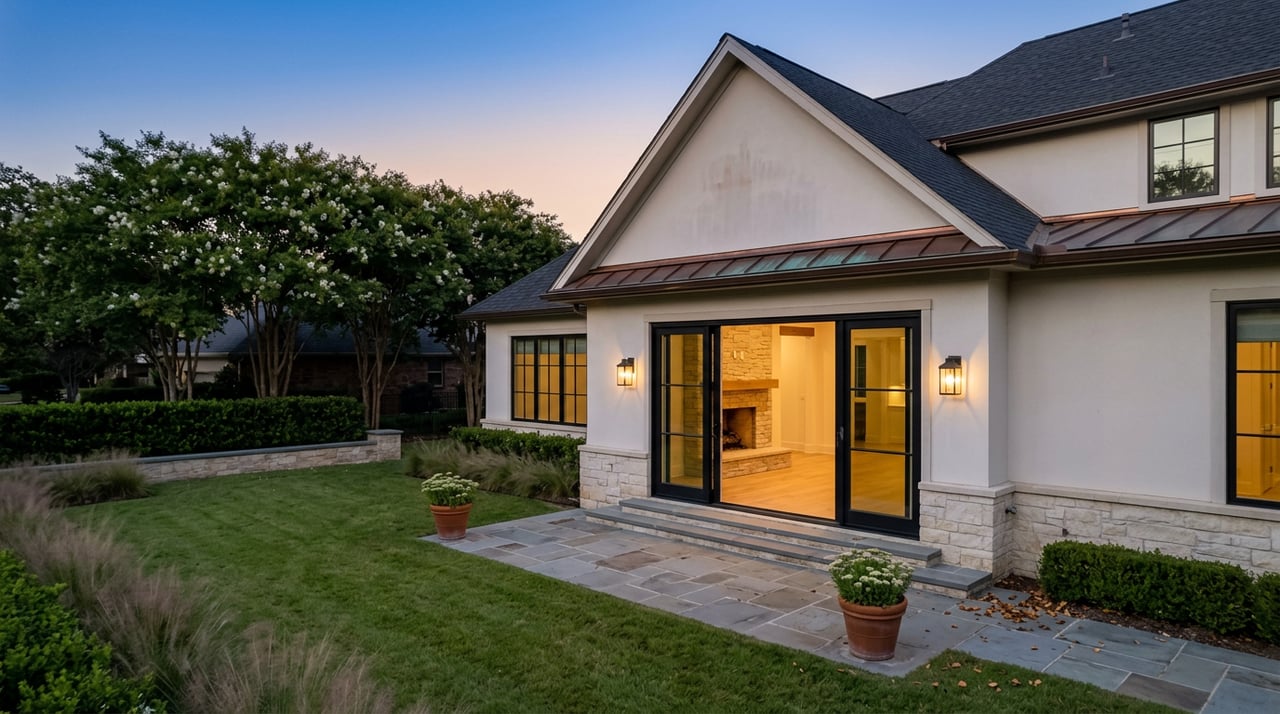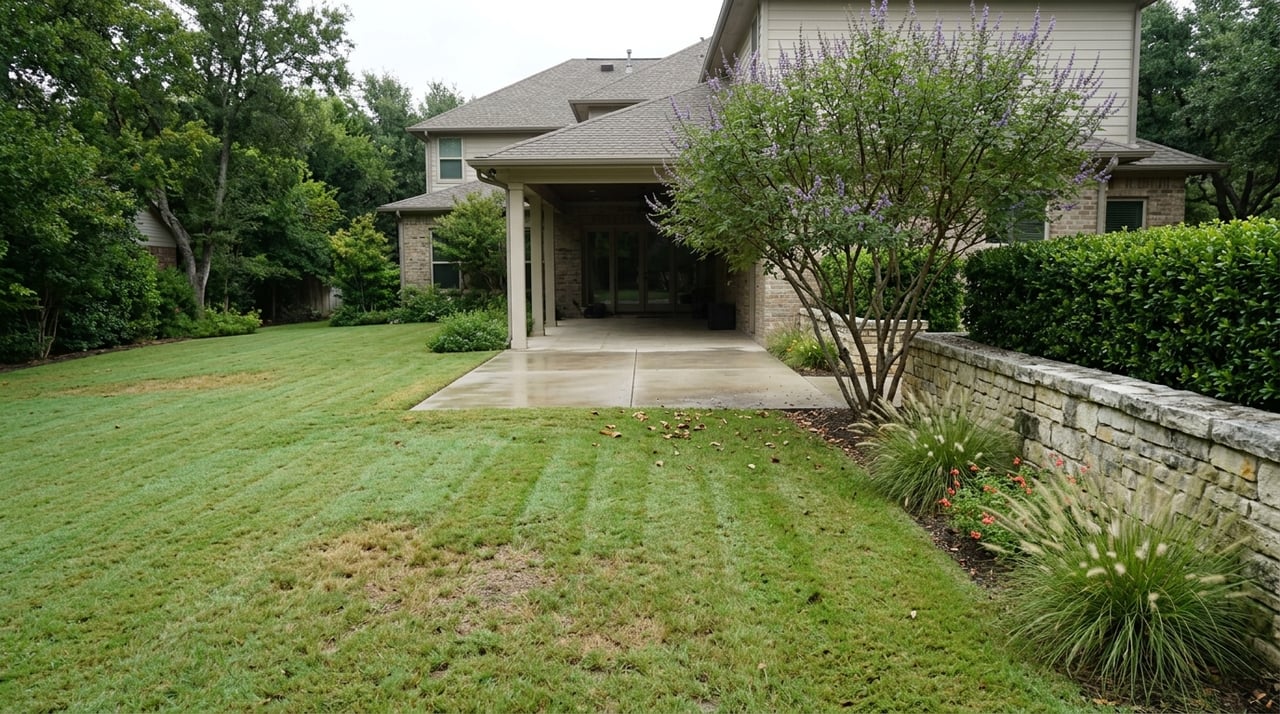
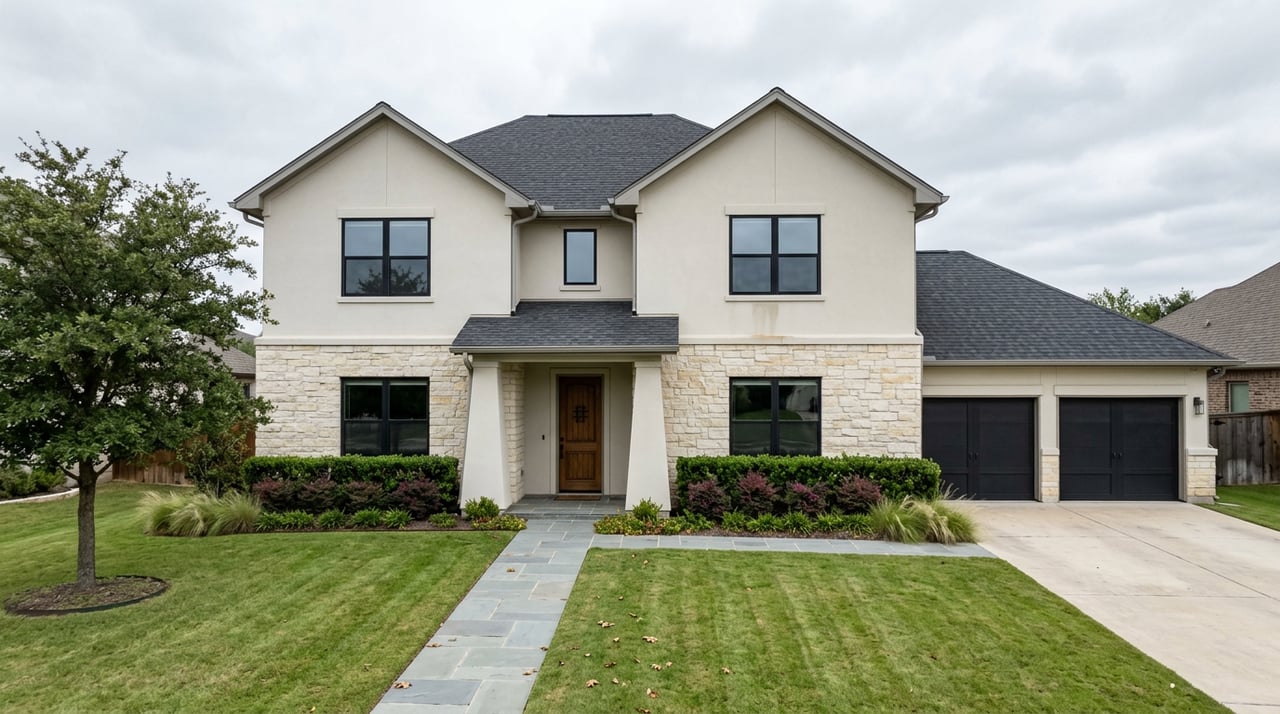
Two identical homes can sit on the same cul-de-sac in The Lakes on Legacy, share a builder, a floor plan, and a mailing address that says Frisco, Texas. One of them can carry a meaningfully different total tax bill than the other. Not because of the school ratings buyers Google before making an offer, and not because of the HOA. Because of a county line that runs straight through the neighborhood, invisible on the ground and largely invisible on the listing sheet.
That is not a hypothetical. The Lakes on Legacy is one of a handful of Frisco communities built directly across the Collin-Denton county boundary, meaning some homeowners pay into Collin County and Frisco ISD while their neighbors a few doors down pay into Denton County and Lewisville ISD. Stonebriar, wrapped around the Stonebriar Country Club, splits the same way, with some homes zoned to Frisco ISD and others to Lewisville ISD depending on which side of the line the lot falls on. Newman Village and The Trails of Frisco sit entirely on the Denton County side, still zoned to Frisco ISD. None of this shows up as a difference in curb appeal. All of it shows up on the tax bill.
Why One City Has Two Tax Systems
Frisco grew fast enough, and outward enough, that it eventually crossed a county line that predates the city's modern footprint by more than a century. Collin County sits to the east, Denton County to the west, and the city itself now straddles both. That single geographic fact means every property in Frisco pays its county taxes to one of two separate governments, each with its own appraisal district, its own rate, and in Collin County's case, an added layer for Collin College that Denton County properties don't carry at all.
Layer school districts on top and the picture gets more specific. Frisco ISD covers most of the city, but Prosper ISD, Lewisville ISD, and Little Elm ISD all have territory inside Frisco's city limits too. School district taxes typically make up the largest single portion of a Texas property tax bill, which means the district a specific address is zoned to often matters more than which city services that address happens to receive.
Put those two variables together, county and school district, and "the Frisco tax rate" stops being one number. It becomes a matrix, and where a specific house lands in that matrix depends on lot lines drawn well before most current owners moved in.
What the Numbers Actually Show
Within Frisco ISD alone, staying in the same school district and comparing only the county difference, recent combined base rate estimates put the Collin County side at roughly 1.675% for the 2025 tax year, against roughly 1.631% on the Denton County side. The prior year told a similar story: about 1.681% on the Collin side versus 1.639% on the Denton side. The gap has held in the same range across both years, even as both sides ticked down slightly.
That gap looks small until it's applied to an actual Frisco home. On a property valued near Frisco's current median sale price, which Redfin's tracked data put at $675,000 over the three months ending in July 2026, a difference of roughly four-hundredths of a percentage point works out to a few hundred dollars a year, every year, for as long as the home is owned. It's not a rounding error. It's also not the kind of number a portal search surfaces, because portals report city, price, and square footage, not which appraisal district will actually be billing the owner.
| County side | School district | Recent combined base rate (approx.) |
|---|---|---|
| Collin | Frisco ISD | ~1.675% (TY2025) |
| Denton | Frisco ISD | ~1.631% (TY2025) |
And that's before a buyer's search happens to land in a different school district altogether. Cross into Prosper ISD, Lewisville ISD, or Little Elm ISD territory within Frisco's borders, and the swing gets larger still, because school rates vary more from district to district than county rates do.
A City Rate That Almost Moved, Then Didn't
This year added a live example of why the city-level number and the address-level number aren't the same conversation. On August 10, 2026, Frisco's City Council approved a maximum property tax rate ceiling of $0.441289 per $100 of valuation for fiscal year 2026-27, a 3.71% increase over the current $0.425517 rate and the first rate increase the city had considered since 2017. City Manager Wes Pierson framed it as reinvestment in aging infrastructure as the city matures past its fastest growth years.
Then, on September 2, the council walked it back. Staff were directed to hold the rate flat at $0.425517, the same figure the city has carried for multiple years running. A final vote is scheduled for September 15, 2026, and the budget would take effect October 1 if approved as directed.
"Frisco continues to grow, and we expect that growth to remain an important part of our future."
That's Deputy Mayor Pro Tem Angelia Pelham, describing the tension the council is navigating, between a city that has finished most of its once-explosive growth and a budget that still needs to fund the roads, parks, and staffing that growth left behind.
Here's the part that matters for anyone comparing houses right now. Even if the city rate holds exactly flat on September 15, the county-and-district matrix underneath it does not disappear. A flat city rate still produces two different total bills depending on which appraisal district and which school district a specific parcel reports to. The headline "Frisco holds its rate steady" is true and, at the same time, incomplete for any one address.
The Exemptions Working in the Other Direction
Two changes currently reduce what Frisco homeowners actually pay, and both apply regardless of which county side a home sits on. The city raised its homestead exemption to 20% of assessed value, the maximum allowed under state law, effective January 2026, which the city estimates saves the average homeowner around $120 a year on the city portion of the bill alone. Separately, the state homestead exemption that applies to school district taxes rose from $100,000 to $140,000 for the 2026 tax year, following a constitutional amendment voters approved in November 2025. That exemption only reduces the value the appraisal district assigns before the rate is applied, so an overassessed home still loses some of the benefit until the assessment itself is corrected.
What This Means While You're Comparing Houses
None of this changes whether a house is worth buying. It changes what "worth it" actually costs to calculate correctly.
- Ask which county a specific address sits in before comparing two listings on price alone. City limits don't tell you this.
- Confirm the exact school district assignment, not just "Frisco ISD" as a default assumption. Four districts have territory inside city limits.
- Request the estimated tax notice for the specific parcel, not a citywide average, especially in neighborhoods known to straddle the line.
- Factor in the homestead exemption timing. It applies once the home is the owner's primary residence, not automatically at closing.
For sellers, the same logic works in reverse. A home on the lower-tax side of a split neighborhood is a genuine, factual selling point, and one that a generic listing description won't surface unless someone points it out.
A Few Questions Worth Asking Directly
Does being on the Denton County side ever hurt resale value later? Not based on anything in the current data. Buyers weigh schools, commute, and home condition far more heavily than which county collects the tax bill. The rate difference affects carrying cost, not the home's underlying value.
Can a buyer choose which county or district a new-construction home lands in? Only by choosing the lot itself. Builders can tell you exactly which appraisal district and school district a specific address in a specific phase reports to well before the slab is poured.
What happens if the September 15 vote changes anything? If the council adopts a rate above $0.425517, it would be Frisco's first increase since 2017, and it would apply citywide regardless of county side. The underlying county-and-district gap described above would still sit on top of whatever the new city number turns out to be.
Frisco's tax story this fall is really two stories running at once: a citywide number that may or may not move on September 15, and an address-specific number that has held steady in shape for years regardless of what the city council decides. Buyers and sellers who understand both are working from the fuller picture. If you're weighing a specific address in Frisco, or comparing it against Plano, McKinney, or another North Dallas suburb, Lori Seale can walk through what a particular parcel's actual tax picture looks like before you write an offer or set a list price.